
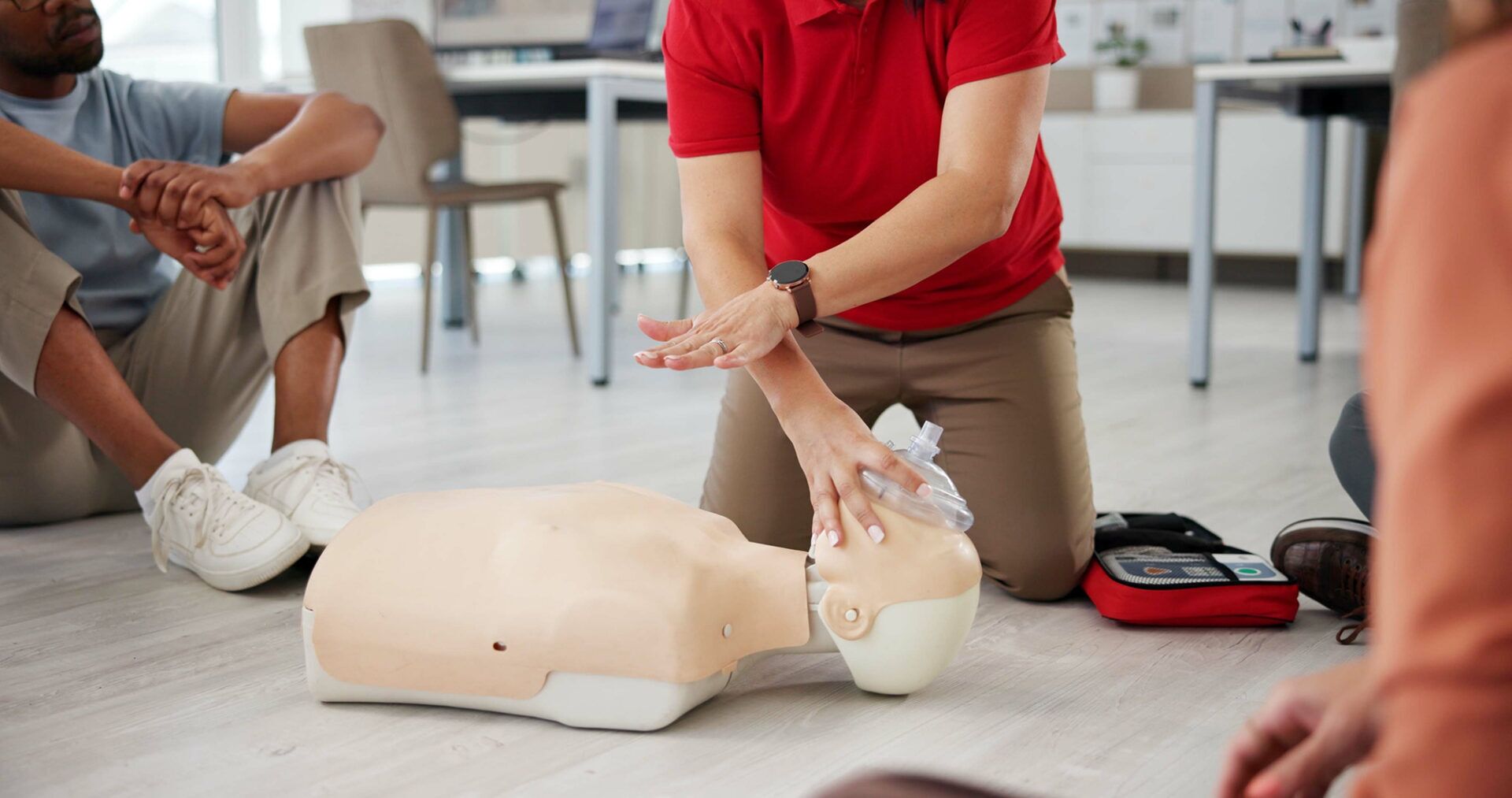
A reversing forklift accidentally strikes a stack of pallets at your workplace. The top pallet tumbles down, hitting a worker with enough force to knock them to the ground and send them into cardiac arrest from the shock. In that critical moment, this story can take one of two directions:
- Path one: Your workplace invested in First Aid training. Your team immediately springs into action, performs CPR, and saves a colleague’s life.
- Path two: No one knows what to do. A preventable tragedy unfolds as a worker under your duty of care dies from trauma-induced cardiac arrest while others watch helplessly.
Which side of this story would you rather be on?
Failing to comply with health and safety duty by ensuring your workers have adequate First Aid training will result in penalties (a maximum of $2.3+M for individuals and $11.5+M for Body Corporates as per penalties under WHS laws) at best and major compensation claims and possible prison sentences at worst. So there really is one choice, and one choice only.
Our Sydney Safety Training experts have compiled this First Aid guide to help business owners and senior management understand obligations and make an informed choice about the proper training for personnel. Use this information to get up to speed quickly and easily, ensuring your business remains fully compliant with SafeWork NSW requirements and you do the right thing.
What Is First Aid?
The term refers to the care or treatment of injuries or illnesses until the recipient recovers or a trained medical professional can take over.
First Aid Requirements in the Workplace
- NSW businesses must provide adequate First Aid equipment in the workplace, and ensure all workers can easily identify and access it.
- They must ensure all workers can access and be treated by colleagues with qualified training.
- The number of workers who require training depends on the sector and its inherent risk (more on this below).
- A facility for administering treatment must also be available at all times.
SafeWork NSW also wants you to meet your duties by involving workers in your First Aid decision-making. This demonstrates an effort by you to be inclusive and improve health and safety outcomes.

How Many First Aiders Are Required in the Workplace in NSW?
The number of adequately trained officers depends on the level of health and safety risk in your workplace. For example, an administration office will typically be deemed low-risk, whilst an industrial site or petrol station (especially one operating at night) will be defined as high-risk.
Low
Retail outlets, offices, libraries, professional services such as agencies, legal offices
1:50
Medium
Medical clinics, educational facilities, supermarkets, food processing outlets
1:25
High
Construction sites, heavy manufacturing industries, water treatment facilities, emergency service outlets
1:10
Workplace First Aid Kit Requirements
As we’ve already mentioned, a kit must be easily located and instantly identifiable. There should be at least one kit in the workplace, and any used items should be immediately replaced or replenished. Contents should include materials that can treat:
Cuts
Sprains or strains
Shock
Scratches
Burns
Amputations
Punctures
Broken bones
Breathing difficulties
Grazes
Major bleeding
Allergic reactions
Splinters
Eye injuries
Make certain that kit contents are protected from moisture, heat, dust, bacteria, vermin, etc. You may require an additional medical kit (for example, defibrillators) depending on the nature of and inherent risks within your workplace.
First Aid Compliance Checklist
This First Aid in the workplace NSW checklist will help guarantee you’re ticking all the best-practice boxes. But remember – embedding training into your work culture isn’t about meeting red tape demands; it’s about maintaining workplace safety and potentially even saving lives.
- Speak to workplace personnel about their WHS needs
- Adequate kit on premises with no items missing
- The correct ratio of trained personnel
- Written emergency procedures circulated to all staff
- Training renewed every three years
- Proper accident or illness record keeping
- Regular internal safety audits
How to Choose a Compliant First Aid Class in Sydney
Use these questions to help find the best First Aid course for your workplace needs:
- Is the course accredited with a Registered Training Organisation (RTO) number?
- Does the course meet current HLTAID011 standards?
- Will you receive a proper certificate/ statement of attainment upon successful completion?
- Is the course a combination of theory and practical learning and assessment?
- Will your training be valid for three years upon successful completion?
- Are all costs transparent, and are there any hidden extras?
The answers to all these questions are yes, with Sydney Safety Training. So, if you want absolute First Aid compliance in the workplace, enrol in one of our courses today.
Why Select Our First Aid Course in Sydney?
- Our HLTAID011 and HLTAID009 courses are nationally recognised, accredited and compliant, and you will receive an official statement of attainment.
- We deliver extensive courses and refresher sessions suited to diverse requirements.
- Our expert instructors possess hands-on industry experience and a deep understanding of First Aid.
- We can come to you and provide on-site training.
FAQs
The Sydney Safety Training courses are valid for three full years.
NSW workplace compliance includes providing the necessary equipment, facilities and appropriately qualified personnel (the ratio of which depends on the sector and risk level).
If by Officer, you’re referring to someone trained in First Aid, yes; your workplace needs to provide this. The number of trained workers depends on the nature of your workplace and the level of risk.
Yes, you can be penalised in Sydney and NSW for not having adequately trained staff (and/or the right number of trained staff).
Sydney Safety Training conducts courses from our purpose-designed facility at 211 Woodville Road, Villawood 2163. In addition, we can come to you and conduct on-site training.
If you are deemed to be a medium or high-level risk workplace, your First Aid kit likely requires more items. However, at a base level, it should provide kit for allergic reactions, splinters, cuts, sprains, strains, burns, shock, eye injuries, grazes, punctures, scratches, breathing problems, bleeding, broken bones, and even amputation.